There’s a kind of luxury that doesn’t announce itself. No logo, no shine, nothing that needs explaining. You just notice, a few hours into the evening, that you’ve forgotten what you’re wearing. For me, that’s what organic Pima cotton is: a fabric whose best qualities are quiet ones.
In this piece I’ll walk you through what makes it different. Pima is an extra-long staple cotton, and those longer fibers spin into a smoother, finer yarn. Ours is certified organic under the Global Organic Textile Standard (GOTS), which covers how the cotton is grown and how it’s processed into fabric. More than 90% of what we make is sewn by small, family-owned partners in Peru, where cotton has been grown for thousands of years. And with gentle care, it’s a fabric that gets softer the longer you live in it.
If you’d like the long version — the fiber, the farm, the certification, and how to make your favorite pieces last — read on.
What “Pima” actually means
Not all cotton is the same plant. Most of the world’s cotton is Upland cotton, with fibers that are relatively short. Pima belongs to a different species, Gossypium barbadense, known for extra-long staple (ELS) fibers. In Peru, Pima fibers often exceed 38 mm, roughly an inch and a half.
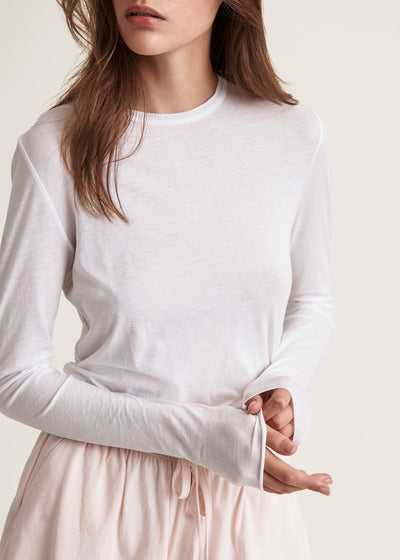
Why does length matter? When fibers are long, fewer loose ends poke out of the spun yarn. The result is a smoother surface, a finer thread, and fabric that’s less prone to pilling. That’s the difference you feel when you pick up a pima cotton long sleeve tee or slip into pima cotton sleepwear for the first time: it’s smooth before it’s even been washed.
One honest note: “Pima” describes the fiber, not how it was farmed. Pima can be grown conventionally or organically. That’s why we talk about organic Pima cotton, and why the certification matters.
Where our cotton comes from: Peru
Cotton isn’t new to Peru. Archaeologists have documented cotton remains on Peru’s northern coast dating back roughly 6,000 years. Pima itself has been grown in the coastal valley of Piura since 1922, and it became one of the country’s signature exports. Today, the organic Pima yarn in our garments is spun from cotton grown in the Ica region, on Peru’s southern coast.
Skin has been making sleepwear and loungewear since 2003, and today more than 90% of our products are made with small-scale, family-owned factory partners in Peru, each one visited and selected by our team. When people search for pajamas made in Peru, this is what I want them to find: not a sourcing slogan, but long relationships with people who know this fiber well.
Why organic, and what GOTS certification covers
“Organic” on a clothing label can mean very different things depending on who’s saying it. That’s why we certify to GOTS, the Global Organic Textile Standard. Here’s what it covers, in plain terms:
• The farm. The cotton must be certified organic under a recognized organic farming standard. Organic farming standards prohibit synthetic fertilizers, synthetic pesticides and genetically modified seed.
• The mill and the factory. GOTS doesn’t stop at the field. All chemical inputs, including dyes and process chemicals, must meet requirements on toxicity and biodegradability, and inputs like heavy metals and aromatic solvents are prohibited.
• The finished product. Finished goods are tested against limits for unwanted residues.
• The people. GOTS also includes social criteria for working conditions throughout the processing chain.
This is the part I care most about as a sustainability lead. When people search for clean manufacturing sleepwear or non-toxic pajamas, what they’re usually asking is: what went into this, and who checked? GOTS is our answer. It’s independent, it covers the whole chain, and it’s auditable.
It’s also worth knowing how small this world still is. Organic cotton accounts for around 1% of the global cotton harvest, according to Textile Exchange. Organic extra-long staple cotton is a smaller slice still. Choosing it is a deliberate decision, not the default.
Organic cotton vs. synthetic fabrics for sleepwear
I’m often asked how organic cotton compares to the polyester and nylon blends common in intimates and sleepwear. Here’s how they differ:
• Fiber origin. Cotton is a plant fiber. Polyester and nylon are made from petroleum-based materials.
• How it feels. Cotton has a dry, matte, natural hand. Many people, me included, find it more comfortable against the skin overnight than a slick synthetic. That’s a matter of preference, and I’ll own it as mine.
• Breathability. Cotton is a breathable fiber, and lightweight cotton jersey lets air move through it. Our Cayla PJ set is cut from a lightweight organic pima cotton jersey for exactly that reason.
• What’s in the finish. With GOTS, the dyes and processing chemicals are restricted and checked. That’s a documented, specific difference — not a general promise.
Why it lasts: the long-wearing case for organic Pima cotton
The most sustainable garment is the one you keep wearing. Extra-long staple fibers make a yarn that holds together well, which is a big part of why Pima pieces tend to resist pilling and keep their shape.
Our customers tell this story better than I can. On the Christine Pant page, one reviewer calls it her favorite lounge pant for five years running, and another says it washes well. On the Double Layer Wrap Robe, one customer mentions she’s on maybe her third.
Organic cotton also asks for a little care. Our care guide comes down to four habits:
1. Wash cold on a delicate cycle with like colors.
2. Use a mild detergent; skip bleach and fabric softener.
3. Air dry when you can, or tumble dry low and remove while slightly warm.
4. If you press, use low heat or a light steam.
Do that, and the fabric softens and becomes more personal over time. Subtle variations in texture and tone are part of the fiber’s nature, not a flaw.
The pieces I reach for
If you’re new to Skin, these are the four I’d start with:
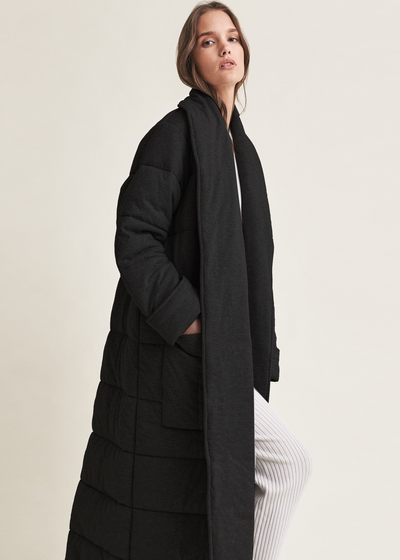
• Double Layer Wrap Robe — our original cult favorite. Two layers of GOTS-certified 100% organic Pima cotton make it soft, breathable and not see-through. Slim sleeves, side pockets, and an attached belt that never goes missing. If you’re shopping for a luxury robe for women that you’ll actually wear every day, this is it.
• Cayla Long PJ Set — a lightweight organic pima cotton jersey set with a notched-collar button-down top and relaxed pants. Classic pajamas, done softly.
• Carissa Sleep Shirt — our best-selling organic cotton sleep shirt: chest pocket, shirttail hem, short sleeves. It works as a nightgown, a beach cover-up, or a day dress.
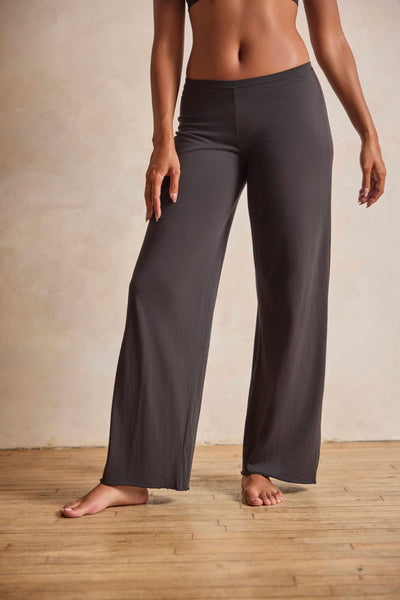
• Christine Pant — full-length, relaxed fit loungewear in 100% GOTS-certified organic Pima cotton, with an elastic waist and side and back pockets. The pima cotton lounge pants I’d stock up on.
Quiet luxury, to me, isn’t about price or labels. It’s about knowing where something came from, how it was made, and that it will still feel good years from now. That’s what we try to put into every piece.
Sources
• Skin homepage · Sustainability · Care Guide for Organic Cotton
• Product pages: Double Layer Wrap Robe, Cayla Long PJ Set, Carissa Sleep Shirt, Christine Pant
• GOTS fact sheet: Control of Chemicals in GOTS Goods
• Ecotextile News on Textile Exchange’s 2021 Organic Cotton Market Report